Five minutes after I signed away my marriage, I was thirty thousand feet above the Atlantic with my two children asleep beside me. At that exact moment, my ex-husband, Marcus Henderson, was celebrating what he believed was the beginning of his perfect new life inside a luxury maternity clinic in New York.
He thought his mistress was carrying the son he had always wanted.
His entire family was gathered around, waiting for good news.
But before the day was over, a single sentence from a doctor would turn their celebration into absolute silence.
And the strangest part was that I already had a feeling something was about to happen.
The pen touched the divorce papers at exactly 10:03 that morning.
I remember the faint scratching sound it made against the thick white paper. Outside the conference room, rain tapped gently against the windows of the Manhattan law office. Somewhere down the hall, a printer hummed. Someone laughed near the reception desk, a bright ordinary laugh that felt strangely offensive on the day my marriage ended.
I stared at my signature for a moment.
Julianne Laurent Henderson.
The letters were smooth and steady.
I was surprised by what I did not feel.
No tears.
No anger.
No trembling hands.
Only a strange, empty peace.
It was the kind of peace that comes when a wound has hurt for so long that the nerves finally stop reporting it.
Across from me, Marcus looked happier than I had seen him in years. He wore the charcoal suit I had bought for his fortieth birthday, the one he claimed made him look like a man who owned every room he entered. His dark hair was freshly cut, his silver cuff links caught the light, and there was an impatient energy in his face, as though our divorce were merely an appointment running longer than expected.
The second our lawyers confirmed the signatures, he pulled out his phone.
He did not wait until he reached the hallway.
He did not look at our children.
He called Penelope.
“Yeah, sweetheart, it’s official,” he said, smiling as he leaned back in his chair. “I’m on my way now. Today’s the big appointment.”
His voice grew louder, as if he wanted every person in the room to hear him.
“Don’t worry. Our son is going to carry on the Henderson name. The whole family can’t wait to meet him.”
My daughter, Lily, sat beside me with her hands folded tightly in her lap. She was nine years old, but that morning she looked much younger. Her blond hair had come loose from its braid, and she kept staring at the pale crescent marks her fingernails were pressing into her skin.
On my other side, eleven-year-old Noah reached for my hand.
Noah was my sister’s child by birth and mine by every choice that mattered. My younger sister, Camille, had died in a winter car accident when Noah was eighteen months old. I had adopted him before I met Marcus. Marcus had spent twelve years introducing him as “Julianne’s nephew,” even though Noah called me Mom and had no memory of anyone else filling that role.
Marcus had never officially adopted him.
He said the paperwork was complicated.
Later, when he believed I was asleep, I heard him tell his father the real reason.
Blood matters.
That was the Henderson family religion.
Blood determined who belonged, who inherited, who sat at the head of a table, and whose mistakes were forgiven.
Lily was Marcus’s biological daughter, but even she had never been enough. The Henderson name, according to Marcus’s father, required a boy. A male heir. Someone who could receive the company, the properties, and the burden of becoming another man exactly like the one before him.
Marcus ended the call and tossed his pen onto the table.
“The condo stays with me,” he said. “The car too. You already agreed to it, so I don’t want any trouble later.”
“There won’t be any trouble,” I replied.
“And if you want to take the kids, go ahead.”
His lawyer glanced at him.
Marcus did not notice.
“They’ll only slow down my new life.”
Noah’s fingers tightened around mine.
Lily lowered her eyes.
For years I had protected them from the sharpest pieces of their father. I had translated his absence into work obligations, his impatience into exhaustion, and his cruelty into stress. I had built soft explanations around a hard man because I believed children deserved to love their father without being asked to judge him.
But there are moments when a lie becomes more damaging than the truth.
That was one of them.
I rested my hand over Noah’s.
Lily looked at me, searching my face for some sign that the world had not just shifted beneath her feet.
I smiled reassuringly, although something inside me was breaking in a quiet, permanent way.
Marcus’s sister, Roxanne, stood near the window with her arms crossed. She had arrived halfway through the meeting carrying a leather handbag and the expression of someone attending an execution she had personally requested.
“Finally,” she said. “Marcus deserves a real woman. Someone who can give this family a son. Not some exhausted housewife dragging around two kids.”
The room fell silent.
Even Marcus’s lawyer looked uncomfortable.
Everyone waited for me to argue.
To cry.
To beg.
The old Julianne might have done all three. The woman who had spent years apologizing for taking up space might have defended herself until her voice disappeared.
Instead, I reached into my handbag, removed the condo keys, and slid them across the polished table.
The metal whispered against the wood.
“What was never truly yours always finds its way back,” I said softly.
Confusion passed over Marcus’s face.
He glanced at the keys, then at me.
“What is that supposed to mean?”
“It means the meeting is over.”
I stood, helped Lily into her coat, and placed Noah’s backpack over my shoulder.
Marcus watched me as though he expected another scene. Perhaps he had imagined me collapsing against him, reminding him of our wedding, asking how he could leave the mother of his child for a woman fifteen years younger.
But I had already begged.
Not that morning.
Months earlier.
I had begged him to attend Lily’s school concert. I had begged him to stop referring to Noah as an obligation. I had begged him to come home before midnight. I had begged him to tell me the truth after I found a hotel receipt in the pocket of his winter coat.
He had looked me directly in the eyes and said I was becoming paranoid.
Then I found Penelope’s photograph on his second phone.
She was standing in our kitchen wearing one of Marcus’s shirts. Behind her, on the refrigerator, was a drawing Lily had made of our family holding hands.
Penelope had taken a photograph beneath it.
That was the night I stopped begging.
Outside the law office, the rain had thinned into a cold silver mist. Traffic moved slowly along the avenue, tires hissing against wet pavement.
A black Mercedes GLS waited at the curb.
The driver stepped out immediately and opened an umbrella.
“Miss Laurent,” he said respectfully. “Your vehicle is ready.”
Marcus stopped behind me.
“What the hell is this?”
I guided Lily toward the car.
Marcus stepped closer.
“Since when can you afford something like that?”
Roxanne came through the revolving door and stared at the vehicle, her lips parting.
The driver took our luggage from the building attendant and placed it in the back.
Marcus looked from the suitcases to me.
“Where are you going?”
I turned toward him.
For one second, I saw the man I had married.
Not the man he had become, but the younger one who used to bring coffee to my architecture studio at midnight. The one who had kissed paint from my fingers and promised that if I trusted him, he would build a life where I would never feel alone again.
I had loved that man.
Perhaps he had been real once.
Perhaps he had only been ambitious.
I still do not know.
“We’re going home,” I said.
“You live here.”
“No,” I answered. “I lived here.”
He took another step, but the driver quietly moved between us.
Marcus’s face tightened.
“You can’t take Lily out of the country without telling me.”
“You signed the relocation agreement twelve minutes ago.”
His expression changed.
He looked toward his lawyer, who had followed him outside.
The lawyer adjusted his glasses. “The clause was in the settlement, Marcus. We reviewed it twice.”
“You said it was temporary travel consent.”
“No,” I said. “You assumed it was.”
His cheeks reddened.
“Julianne, stop. Where are you taking my daughter?”
The use of my daughter made Noah flinch.
I saw it.
Marcus did not.
“Somewhere she will never have to compete with an unborn child for permission to matter.”
I turned away.
There was no explanation.
No goodbye.
Only the solid closing sound of the Mercedes door and the sensation of my children’s hands finding mine in the quiet back seat.
Memory has no respect for clocks. In my heart, I was above the Atlantic five minutes after signing those papers. In reality, there were four hours between the law office and takeoff, but pain folds time in strange ways. Some hours last years. Some years vanish between two breaths.
At John F. Kennedy International Airport, we moved through a private departure lounge arranged by my father’s office. Lily stayed close to me. Noah watched the planes through the glass.
Neither child asked why our tickets carried the Laurent name.
Neither asked how a driver knew where to collect us or why an airport representative greeted me as though she had been expecting us for weeks.
They were too tired, and I was not ready to explain everything.
Marcus had known that my family lived in France. He knew my father owned a group of hotels and restoration properties across Europe. What Marcus never understood was the scale of it, partly because I had hidden it and partly because he had never cared enough to ask.
My grandfather had founded Laurent Maison after the Second World War, beginning with a twelve-room inn outside Lyon. By the time I was born, the company owned historic hotels, vineyards, and residential properties in seven countries.
After my mother died, I inherited her controlling interest through a protected family trust.
I had walked away from its daily operations at twenty-seven because wealth had turned every relationship around me into a question. I wanted to know who I was without the Laurent name. I wanted a life built from work, not inheritance.
Then I met Marcus.
He loved that I was independent. At least, that was what he said.
When he learned about the trust, his admiration changed into discomfort. He asked me not to involve my family in our marriage. He said he needed to know that everything we achieved belonged to us.
So I stepped farther away from my father.
I used my design skills to help Marcus open his development company. I drafted his earliest proposals after midnight, introduced him to investors without revealing the family connection, and placed six million dollars from my trust into a silent investment fund that kept his company alive during its first three years.
Marcus called himself self-made.
I let him.
I believed love did not need a receipt.
By the time I understood that Marcus viewed gratitude as weakness, my father and I had barely spoken in five years.
Three weeks before the divorce, I called him.
He answered on the first ring.
I had prepared a speech. I planned to apologize for the holidays missed, the calls ignored, and the way I had allowed my husband’s insecurity to separate me from the last parent I had left.
But the moment I heard my father’s voice, I could not speak.
“Julianne?” he said.
I covered my mouth.
He waited.
Then he said the words I had not known I needed.
“Come home, ma chérie. You do not have to explain before you are safe.”
That was all.
No anger.
No punishment.
No demand that I admit he had been right about Marcus.
Only a door opening across an ocean.
On the plane, Lily sat by the window. Noah occupied the middle seat, his head resting against my shoulder. We had just crossed the coastline when the seat belt sign went dark.
Below us, the Atlantic spread into a field of deep blue cloud-shadowed water.
Lily stared outside.
“Is Dad going to call?”
The question was quiet.
“He might.”
“Will you make me talk to him?”
“No.”
She turned toward me. “Is that bad?”
“What?”
“That I don’t want to.”
I brushed a loose strand of hair from her face.
“No, sweetheart. Feelings are not bad. They are information. Sometimes they tell us where we are hurt.”
She looked down at the blanket over her knees.
“He said we’d slow him down.”
“I know.”
“Did he mean it?”
There are questions mothers want to protect their children from, but children can hear hesitation more clearly than language.
“I think your father was thinking only about himself,” I said. “People say cruel things when they are determined not to feel the harm they are causing.”
Noah opened his eyes.
“He never called me his son.”
My heart tightened.
“Noah.”
“It’s okay.” He swallowed. “I knew.”
I turned toward him fully.
“He was wrong.”
“He said blood matters.”
I closed my eyes for one second.
Marcus had not merely failed to love Noah. He had taught the boy to measure himself against a biology he could never change.
I took Noah’s face gently between my hands.
“Listen to me. Family is not a prize people earn by sharing blood. Your mother gave you life, and when she could not stay, she trusted me to continue loving you. I chose you in every hospital room, every school meeting, every fever, every nightmare, every ordinary morning. You are not almost my son. You are my son.”
His mouth trembled.
Lily leaned across him and wrapped both arms around us.
For a while, the three of us stayed that way beneath the dim cabin lights, holding one another while the plane carried us toward the home I should never have abandoned.
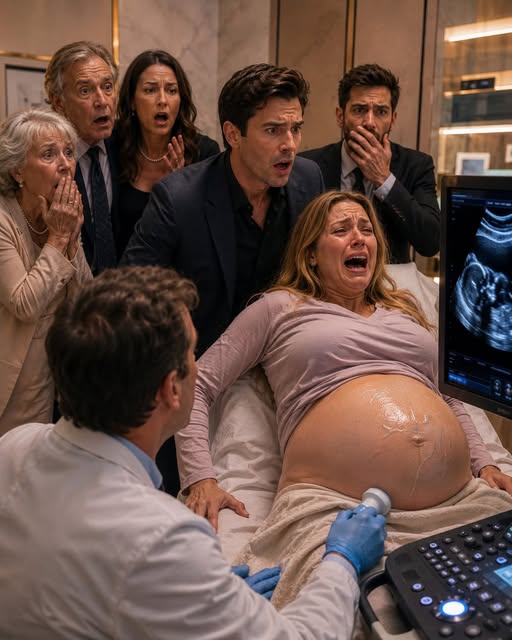
At that same hour, the Henderson family was gathering on the twenty-second floor of the Vance Maternal Medicine Center in Manhattan.
I learned the details later from Marcus, from court testimony, and from a nurse whose statement became part of the investigation that followed. By then, every word spoken in that room had been repeated so many times that it felt as if I had stood there myself.
Penelope Price lay on the examination bed wearing a cream-colored maternity dress. Her auburn hair was arranged over one shoulder, and a diamond pendant rested against her throat.
The pendant had belonged to Marcus’s mother.
Helen Henderson noticed it the moment she entered the room.
“That necklace looks familiar,” she said.
Penelope touched it instinctively.
“Marcus gave it to me.”
Marcus, who had just arrived, paused near the door.
“I did?”
Penelope’s eyes moved toward him.
Then she laughed.
“You left it in the jewelry box for me.”
Marcus looked confused, but Roxanne interrupted before he could respond.
“Can we not ruin today over a necklace? We’re here to see the next Henderson man.”
Edwin Henderson stood near the windows with one hand in his pocket. At sixty-eight, Marcus’s father still carried himself like the executive he had been for four decades. His hair was white, his posture rigid, and his expression controlled.
He did not look at Penelope.
According to the nurse, Penelope looked at him repeatedly.
Marcus was too busy greeting the clinic photographer Roxanne had hired to notice.
He had arranged champagne in a private recovery room. Blue flowers waited beside a cake decorated with the Henderson crest. He had even brought a tiny navy blanket embroidered with the initials M.H. Junior.
Penelope smiled when he placed it beside her.
Her smile did not reach her eyes.
Dr. Samuel Vance entered with a tablet under one arm.
He was a quiet man in his fifties, known for explaining difficult medical information without stripping patients of hope. He greeted the family, reviewed Penelope’s blood pressure, and asked whether she wanted everyone to remain in the room.
“Yes,” Penelope said quickly. “They should all hear it.”
Dr. Vance glanced at her.
“Are you certain?”
“Completely.”
Marcus pulled a chair closer to the examination bed.
“Let’s see my boy.”
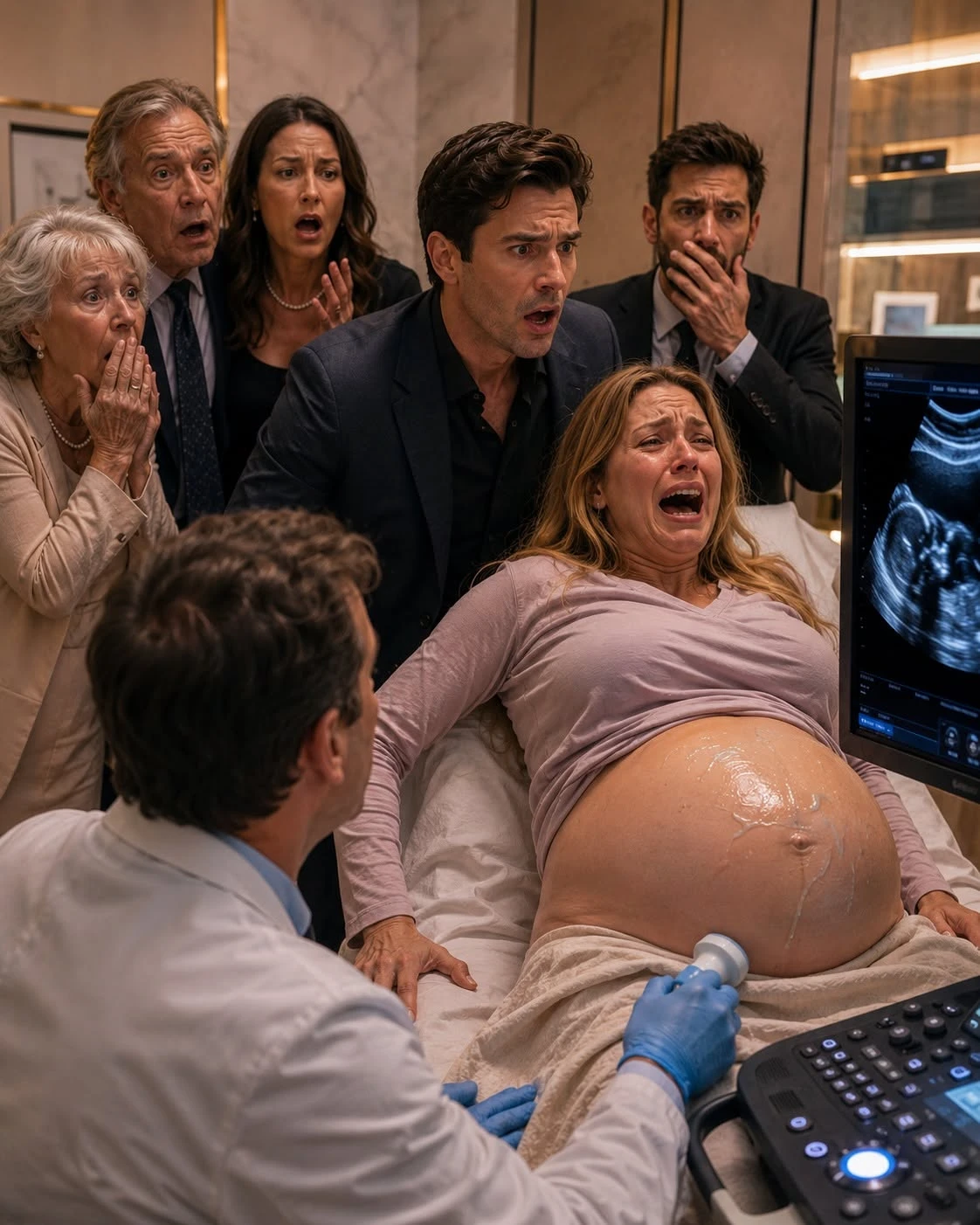
The doctor dimmed the lights and placed warm gel across Penelope’s stomach. The monitor flickered. Gray shapes shifted across the screen, resolving into the curved spine and moving limbs of a twenty-two-week fetus.
A heartbeat filled the room.
Fast.
Steady.
For a moment, everyone relaxed.
Marcus laughed and placed a hand over Penelope’s.
“There he is.”
Helen began to cry.
Even Edwin turned toward the screen.
Dr. Vance moved the ultrasound wand slowly.
His attention sharpened.
He measured the fetus’s head, heart, kidneys, and limbs. Then he returned to the heart.
The room grew quieter.
Marcus leaned forward.
“Is something wrong?”
Dr. Vance did not answer immediately.
He changed the angle of the image and studied the monitor again.
Penelope’s smile disappeared.
“What is it?”
“There is a small ventricular defect,” he said. “A hole between the lower chambers of the heart. It may close naturally, but given the genetic screening results, we need to discuss it carefully.”
Marcus frowned.
“What genetic results?”
Dr. Vance looked at Penelope.
“You received my message yesterday?”
“Yes.”
“You told me the laboratory made a mistake.”
“The laboratory repeated the analysis twice.”
Marcus released Penelope’s hand.
“What analysis?”
Dr. Vance turned on the lights.
The sudden brightness made everyone blink.
He placed the ultrasound wand in its holder and removed his gloves with measured care.
“Mr. Henderson, you requested noninvasive prenatal paternity confirmation as part of the family genetic screening.”
Marcus nodded. “Of course. My family has a history of cardiomyopathy. We wanted everything checked.”
“Your father and mother also provided genetic samples last month because of that history.”
“Yes.”
Dr. Vance held the tablet against his chest.
His face had changed. He no longer looked merely concerned. He looked like a man choosing which wall to break through because every available door led somewhere terrible.
Roxanne shifted beside the cake table.
“Well, Doctor?”
Penelope stared at the ceiling.
Edwin’s face had gone pale.
Dr. Vance looked directly at Marcus.
“Mr. Henderson, the child Penelope is carrying is not your son.”
Marcus blinked.
No one moved.
Then the doctor continued.
“Genetically, he is your half brother.”
The fetal heartbeat still pulsed through the speakers.
One hundred and forty-eight beats per minute.
A living metronome inside a room where time had stopped.
Marcus stared at Dr. Vance as though the words had been spoken in another language.
“What?”
“The laboratory found no paternal match between you and the fetus,” Dr. Vance said. “There is, however, a direct paternal match with your father.”
Helen made a small sound.
Not a scream.
Something lower.
Something pulled from a place beneath language.
She turned toward Edwin.
He did not look at her.
Roxanne’s hand flew to her mouth.
Marcus began to laugh.
It was not amusement. It was the mind’s last defense against an impossible reality.
“No. That’s absurd. You mixed up the samples.”
“The laboratory repeated the test using a second blood draw.”
“No.”
“Marcus,” Penelope whispered.
He looked at her.
The expression on her face told him before she spoke.
His laughter stopped.
“How long?”
Penelope’s eyes filled with tears.
“Marcus.”
“How long have you been sleeping with my father?”
Edwin stepped forward. “Lower your voice.”
Marcus turned so quickly that the chair behind him fell.
“You don’t get to tell me what to do.”
“This is a medical facility.”
“You got my girlfriend pregnant.”
Penelope sat up, clutching the sheet over her stomach.
“I was with Edwin before I was with you.”
That sentence struck harder than the doctor’s revelation.
Marcus stared at her.
“What did you say?”
Penelope wiped her face.
“Your father and I met almost two years ago.”
Helen gripped the edge of a cabinet.
Edwin remained silent.
Penelope continued, her voice trembling but clear.
“He said his marriage was already over. He said he was waiting for the right time to leave.”
Helen looked at her husband.
“Two years?”
Edwin’s jaw tightened.
Penelope pressed a hand to her stomach.
“When I became pregnant, Edwin panicked. He said a child would destroy everything. He wanted me to disappear until after the birth.”
Marcus looked sick.
“So you started sleeping with me?”
“I already knew you. You came to the apartment.”
“What apartment?”
Penelope’s eyes moved toward Edwin.
“The one he paid for.”
Marcus’s hands curled into fists.
I had found the payments three months before the divorce.
Seventeen thousand dollars each month transferred from a Henderson corporate account to a property company that owned Penelope’s apartment. The authorization carried Edwin’s executive code.
I showed the records to Marcus.
He barely looked at them.
“My father manages dozens of properties.”
“Penelope lives there.”
“Then it’s probably part of her compensation package.”
“She works in marketing. No marketing assistant receives a seventeen-thousand-dollar apartment.”
Marcus had laughed.
“You’ve been watching too many crime shows.”
I told him something was wrong.
I told him Penelope might be using him.
I told him to wait for the paternity results before announcing the baby to the world.
He accused me of trying to poison his happiness because I had failed to give him a son.
Now, inside the clinic, every warning returned at once.
Marcus pointed at Penelope.
“You used me as cover.”
“I was trying to protect my baby.”
“By telling me he was mine?”
“You wanted him to be yours. You never asked questions.”
“I asked for a paternity test.”
“After you announced the pregnancy to everyone we knew.”
Edwin finally spoke.
“That is enough.”
Helen turned toward him.
Her face had become eerily calm.
“Did you give her my necklace?”
Edwin glanced at the diamond pendant against Penelope’s throat.
Helen understood.
She crossed the room and removed her wedding ring.
For forty-three years, that ring had never left her hand.
She placed it on the examination table.
“You did not betray our family in one moment,” she said. “You built a second life using pieces stolen from the first.”
Edwin reached for her.
Helen stepped away.
Marcus moved between them.
The anger in his face looked almost childlike. Beneath the expensive suit and practiced confidence stood a boy who had spent his entire life trying to become his father, only to discover that the man he worshipped had used his weaknesses against him.
“You knew I wanted a son,” Marcus said.
Edwin looked down.
“You knew what this meant to me.”
“That does not excuse what happened.”
“No. It explains how you hid it.”
Marcus turned back to Penelope.
“Did you ever love me?”
She closed her eyes.
The answer arrived before her words.
“I thought I could.”
He recoiled.
Roxanne began gathering her coat and handbag with shaking hands.
“What about the baby’s heart?” she asked.
Dr. Vance had remained near the monitor, giving the family space without abandoning the patient.
“The defect requires additional imaging,” he said. “The shared family mutation increases the risk of cardiomyopathy, but it is too early to predict the outcome. The baby is alive. Right now, our responsibility is to him.”
The baby was alive.
That truth stood in brutal contrast to everything else dying in the room.
Marcus looked at the tiny figure on the monitor.
Minutes earlier, he had imagined teaching that child to throw a ball, signing his first school forms, and placing the Henderson company in his hands.
Now the child was his brother.
His father’s son.
The family heir Marcus had been trained to desire had arrived in the most humiliating way possible.
At 4:27 that afternoon, while our plane crossed a belt of pale clouds over the Atlantic, Marcus called me.
I was awake.
Lily and Noah were sleeping beneath their blankets. The cabin lights had been lowered, and the sky beyond the window had turned the color of dark glass.
Marcus’s name appeared on my phone.
I watched it ring twice before answering.
He was breathing hard.
“You knew.”
There was no greeting.
No question about Lily.
No question about whether we were safe.
Only accusation.
“I suspected.”
“You knew Penelope was sleeping with my father.”
“I knew your father was paying for her apartment. I knew he had purchased the necklace she wore. I knew she was seeing someone before you.”
“Why didn’t you tell me?”
“I did.”
Silence.
“You showed me financial records.”
“And photographs.”
I had found a photograph in Edwin’s office during a company dinner. Penelope stood beside a fireplace in a red dress, Edwin’s hand resting on the small of her back. The date in the corner was six months before Marcus claimed to have met her.
He had refused to look at it.
“You should have tried harder,” Marcus said.
Something cold moved through me.
“For twelve years, I tried harder.”
“This is different.”
“No, Marcus. It is the same. You ignored what was in front of you because the lie made you feel important.”
He lowered his voice.
“The baby is my brother.”
“I know.”
“How can you sound so calm?”
“Because I have two children sleeping beside me who need me to remain calm.”
At last, he remembered them.
“Where is Lily?”
“Beside me.”
“Put her on the phone.”
“No.”
“I’m her father.”
“This morning, you said she would slow down your new life.”
“I was angry.”
“You were relieved.”
His breathing changed.
“Julianne, I made a mistake.”
The words might have destroyed me six months earlier. I had dreamed of hearing them. I had imagined Marcus arriving home with honesty in his eyes, asking me to help him repair what he had broken.
But there are apologies that come too late because they are not born from understanding. They are born from consequences.
“You made thousands of choices,” I said. “The mistake was believing none of them would cost you anything.”
“Come back.”
I looked at Lily’s sleeping face.
“No.”
“We can fix this.”
“There is no this anymore.”
“I’ll end it with Penelope.”
A sad laugh escaped me.
“She already ended it with you.”
“That isn’t what I mean.”
“I know exactly what you mean. You want the old life waiting because the new one collapsed.”
He said nothing.
Below us, invisible in the darkness, the ocean went on for thousands of miles.
“I loved you,” I told him. “I loved you enough to disappear inside your ambitions. I made your excuses for you. I softened your words for the children. I let you call my work support and your work success. I let you reduce Noah to someone else’s blood and Lily to the wrong kind of heir.”
My voice broke for the first time that day.
“You did not lose me at the clinic, Marcus. You lost me slowly, every time I asked you to look at us and you chose a mirror instead.”
He began to cry.
I had heard Marcus angry, tired, triumphant, and drunk.
I had never heard him cry.
For a moment, tenderness rose from an old reflex inside me. I almost comforted him.
Then Noah shifted in his sleep and whispered, “Mom.”
The reflex died.
“Do not call again tonight,” I said.
“Julianne.”
“Goodbye, Marcus.”
I ended the call.
Several hours later, morning light poured across the cabin as we descended over France. The landscape below appeared in squares of green and gold, divided by narrow roads and stone villages.
Lily pressed her face to the window.
“It looks like a storybook.”
“It does,” I said.
My father was waiting at the airport in Lyon.
Etienne Laurent had aged since I last saw him. His shoulders were narrower, and there was more white in his hair, but he still wore the navy wool coat I remembered from childhood winters.
He stood behind the security barrier holding no flowers and making no effort to hide his tears.
The moment Lily saw him, she hesitated.
My father lowered himself to one knee.
“You must be Lily,” he said.
She nodded.
“I have a room waiting for you with a window facing the orchard. Your mother said you like to draw.”
Lily looked at me, surprised.
Then she ran into his arms.
Noah remained beside me.
My father stood and faced him.
“And you are Noah.”
Noah’s expression became guarded.
“Yes, sir.”
My father placed a hand over his heart.
“I knew your mother. She laughed louder than anyone in our family. You have her eyes.”
Noah’s face crumpled.
My father did not ask permission before embracing him.
He simply opened his arms.
Noah stepped into them.
Watching the three of them together, I understood that home was not always the place you had stayed. Sometimes it was the place that kept a light burning after you had convinced yourself you no longer deserved to return.
We drove south to the Laurent estate outside Avignon. It was not a palace, although Marcus had always described it that way. It was an old limestone house surrounded by olive trees, lavender fields, and low hills that turned purple at sunset.
My childhood bedroom had been prepared for me.
On the pillow lay a photograph of my mother and Camille laughing beside the garden fountain.
I sat on the bed and held it for a long time.
Then I finally cried.
Not for Marcus.
Not entirely.
I cried for the years I had spent trying to make myself small enough for his pride. I cried for Noah, who had learned to doubt his place in our family. I cried for Lily, who had heard her father discard her before she was old enough to understand that his failure had nothing to do with her worth.
My father sat beside me without speaking.
When my tears slowed, he took my hand.
“You are allowed to grieve a life even when leaving it saved you.”
That night, Lily slept in the room overlooking the orchard. Noah slept across the hall beneath a quilt my mother had sewn for Camille.
For the first time in years, I slept without listening for a key in the front door.
In New York, the Henderson family began collapsing before sunset.
Helen left Edwin at the clinic and checked into a hotel. Roxanne deleted the photographs she had posted online, but not before friends and company employees had taken screenshots of the blue cake and the caption welcoming the future Henderson heir.
Penelope was admitted overnight for observation because her blood pressure had risen dangerously.
Marcus returned to the condo alone.
He found a courier waiting with a sealed package.
Inside were documents from Laurent Capital, the investment entity that had financed his development company twelve years earlier.
For the first time, Marcus saw my full name printed beneath the trust seal.
Julianne Celeste Laurent, controlling beneficiary.
He called his corporate attorney.
The attorney explained that the divorce did not remove my trust’s ownership stake because those assets had never been part of the marriage. More importantly, an audit had uncovered unauthorized withdrawals approved by Edwin.
The apartment.
The jewelry.
Private travel.
Cash transfers to Penelope.
Nearly four million dollars had been taken from corporate accounts over two years.
The company’s board placed both Edwin and Marcus on temporary leave while investigators reviewed the transactions. Marcus had not authorized the theft, but he had signed financial statements without reading them.
For years, he had accepted praise for the company’s growth while leaving its details to other people.
Now that carelessness had a price.
He called me again the next morning.
I did not answer.
He sent twelve messages.
The first blamed his father.
The second blamed Penelope.
The third blamed the board.
By the seventh, he blamed himself.
The final message contained only five words.
I did not see you.
I read it once, then placed my phone facedown.
Sometimes recognition is not reconciliation.
The weeks that followed were quiet in France.
Lily began attending a small bilingual school near the estate. Noah joined a local football club and spent afternoons helping my father repair an old stone wall around the vineyard.
I returned to architecture.
Not Marcus’s projects.
My own.
The Laurent Foundation was converting an abandoned monastery into temporary housing for women and children leaving dangerous homes. The building had arched windows, cracked frescoes, and a courtyard where weeds grew through pale stone.
Every morning, I walked through its empty rooms with rolled plans beneath my arm.
I designed bedrooms with doors that locked from the inside.
Kitchens filled with natural light.
Reading corners for children who needed somewhere quiet to breathe.
I understood that architecture was not only about beauty.
It was about deciding what people deserved to feel inside a space.
Safety.
Dignity.
Belonging.
Three months after the divorce, Penelope gave birth prematurely.
Her son arrived at thirty-one weeks following a placental abruption. He weighed three pounds and required immediate heart surgery.
Marcus learned through Roxanne.
For several hours, he sat alone in his car outside the hospital.
He hated Penelope.
He hated Edwin.
He hated the child’s existence because it embodied every humiliation he could not escape.
Then he remembered the heartbeat in the ultrasound room.
The child had not chosen any of it.
Marcus entered the neonatal intensive care unit shortly after midnight.
Penelope was still in surgery. Edwin had suffered a stroke two weeks earlier and remained in a rehabilitation center under police supervision while financial investigators prepared charges.
The baby lay beneath a clear plastic cover, surrounded by wires and soft mechanical sounds.
A nurse asked Marcus who he was.
He stared at the child.
The tiny boy had Marcus’s dark hair and the Henderson cleft in his chin.
For one irrational second, Marcus imagined the doctor had been wrong.
Then the truth settled again.
“I’m his brother,” he said.
The nurse checked her chart.
“What is the baby’s name?”
Marcus looked toward the empty space on the form.
Penelope had not chosen one.
He thought about the embroidered blanket marked M.H. Junior. He thought about the name he had expected the child to inherit and the damage men had done trying to preserve it.
“Gabriel,” he said.
Penelope approved the name when she regained consciousness.
Gabriel survived the surgery.
For several weeks, Marcus visited him every evening. He sat beside the incubator and read children’s books aloud, although the baby was too young to understand. He learned how to slide one finger through the opening in the plastic wall so Gabriel could wrap a hand around it.
The first time those tiny fingers closed around his, Marcus wept.
For one brief moment, holding the hand of the boy he had expected to call his son, something inside him softened.
Then the nurse asked whether Marcus had other children.
He thought of Lily.
He thought of Noah.
He thought of the way Noah had squeezed my hand in the lawyer’s office after hearing that he would slow down Marcus’s life.
Marcus lowered his head.
“Yes,” he whispered.
“Do they visit?”
“No.”
He could not explain that one child lived an ocean away because he had thrown her love aside, while the other had spent twelve years waiting for Marcus to call him son.
Gabriel recovered gradually.
Penelope moved to Connecticut with her mother after leaving the hospital. She allowed Marcus to visit the baby but wanted no further relationship with him. Her evidence helped prosecutors build the financial case against Edwin.
Helen filed for divorce.
Roxanne stopped speaking to her father.
The Henderson family home was sold to repay corporate losses.
Marcus lost his position as chief executive, although the board spared the company by restructuring it under independent leadership. He returned to work months later as a project consultant, with no private office and no title beneath his name.
For the first time in his adult life, nobody treated him as an heir.
He was simply a man with consequences.
He began therapy.
He wrote to Lily and Noah every Sunday.
The first letters were full of explanations. I did not give those to the children.
Later letters became simpler.
I am sorry I missed your concert.
I am sorry I made you feel unwanted.
I was wrong about what makes a family.
I do not expect you to forgive me.
I will keep writing unless you ask me to stop.
Noah asked him to stop.
Marcus did.
Lily never asked.
She kept the letters in a wooden box beneath her bed but did not answer them.
Eighteen months passed.
The monastery opened as Maison Camille, named for my sister. On the first morning, six families arrived carrying suitcases, plastic bags, and the stunned expressions of people who had escaped something but had not yet learned how to feel safe.
Lily painted a mural in the children’s room.
Noah helped assemble bookshelves.
My father stood in the courtyard and watched us with tears in his eyes.
I had not remarried. I was not searching for anyone. My life no longer felt like an empty place waiting to be occupied.
It felt full.
Then, one September afternoon, Lily came into my office holding the wooden box of letters.
“I want to see Dad.”
I put down my pencil.
“Are you sure?”
“No.”
That answer made me smile sadly.
“You don’t have to be sure.”
“I need to ask him something.”
“What?”
She looked toward the courtyard where Noah was teaching Gabriel, who had come to France with Penelope for a cardiac consultation funded by our foundation, how to roll a wooden ball across the stones.
Marcus had not come with them.
Lily watched the little boy laugh.
Then she turned back to me.
“I want to ask Dad if I can change my last name.”
My chest tightened.
“To Laurent?”
She nodded.
“I don’t want Henderson to be the first thing people know about me.”
“You can use Laurent socially now. Legally, we need his consent.”
“That’s why I want to see him.”
I studied her face.
“Changing your name will not change who your father is.”
“I know.”
“Do you want it to?”
She thought for a moment.
“No. I just don’t want his name to be something I have to carry for him.”
We arranged the meeting in London at a quiet public garden near the Thames.
Marcus arrived early.
I almost did not recognize him.
He had lost weight, and gray threaded his hair near the temples. He wore no expensive watch. No cuff links. His coat was simple and slightly too large.
When Lily appeared beside me, he stood.
For a moment, neither moved.
Then Marcus whispered, “Hi, Lily.”
“Hi, Dad.”
His eyes filled.
She had grown taller. Her hair reached her shoulders, and she carried herself with a steadiness that had not existed on the day of our divorce.
Marcus looked at me.
“Thank you for bringing her.”
“This was her choice.”
We sat on a bench beneath a plane tree. Leaves drifted across the path, scraping softly over the pavement.
Marcus spoke first.
“I have rehearsed what I wanted to say, but everything sounded like I was trying to make you understand me.” He looked at Lily. “You should not have to understand me. I should have understood you.”
Lily remained silent.
“I was cruel,” he continued. “I made you believe your value depended on being the child I expected instead of the person you were. I spoke about a son as though I did not already have children.”
His voice shook.
“I abandoned you before you ever left.”
Lily’s eyes glistened, but she did not look away.
Marcus reached into his coat and removed a folded sheet of paper.
It was a drawing Lily had made when she was six.
Four figures stood in front of a yellow house. One was me. One was Noah. One was Lily. The fourth was Marcus, drawn taller than everyone else, holding Lily’s hand.
“I found this in my desk,” he said. “I don’t remember putting it there.”
“I gave it to you,” Lily replied. “You said you were busy.”
He closed his eyes.
“I’m sorry.”
She studied the drawing.
“Do you love Gabriel?”
Marcus looked surprised.
“Yes.”
“Even though he’s your brother?”
“Yes.”
“Would you have loved him less if he were a girl?”
He inhaled slowly.
“The man I was might have.”
Lily nodded.
“At least that’s honest.”
Marcus looked toward me, but I gave him nothing to hide behind.
Lily opened her bag and removed the legal documents my attorney had prepared.
“I need you to sign something.”
Marcus took the papers.
He read the first page.
His face changed.
“Petition for surname modification,” he whispered.
“I want to be Lily Laurent.”
He looked at her.
“Because you hate me?”
“No.”
The answer seemed to give him hope.
Lily leaned closer.
“I don’t hate you, Dad. I waited a long time to hate you, but it never happened.”
Marcus’s mouth trembled.
“I still remember you teaching me to ride my bike. I remember the pancakes you made when Mom was sick. I remember falling asleep on your chest when I was little.”
A tear slid down his face.
Lily continued.
“Those things were real. The bad things were real too.”
Marcus nodded.
“I know.”
“For a long time, I thought forgiving you meant pretending one of those versions was false.”
She placed her hand over the papers.
“Now I think forgiveness means I can remember both and still choose what happens next.”
Marcus stared at her.
“What happens next?”
“I become Lily Laurent.”
He lowered his eyes.
The garden seemed to hold its breath.
A child laughed near the fountain. Somewhere beyond the trees, a boat horn sounded on the river.
Marcus turned to the signature page.
His hand shook as he took out a pen.
For twelve years, he had worshipped his surname. He had measured children by their ability to preserve it. He had destroyed his marriage chasing the fantasy of a boy who would carry it forward.
Now his only biological daughter was asking permission to put it down.
He signed.
Marcus Henderson.
The same name he had fought so hard to protect became the name releasing her from it.
Lily looked at the signature.
“Thank you.”
He returned the papers.
“Is that all you needed?”
She placed them inside her bag.
“Yes.”
The hope in his face dimmed.
Then Lily stood and stepped toward him.
Marcus rose slowly.
She wrapped her arms around his waist.
For one beautiful second, his face filled with pure relief. He held her as though someone had returned his entire life. His eyes closed, and his hand rested against the back of her head.
I could almost see the future he imagined.
More meetings.
Phone calls.
Birthdays.
A gradual road back into her heart.
Then Lily whispered something.
I did not hear it at first.
Marcus did.
His expression collapsed.
She stepped away.
“What did you say?” he asked, although he had heard her clearly.
Lily’s eyes filled with tears.
“I said goodbye, Dad.”
Marcus stood frozen.
“I can keep writing.”
“You can,” she said. “But I won’t be waiting anymore.”
She turned and walked toward me.
Marcus did not call her back.
Perhaps that was the first truly loving thing he had done for her.
He let her go without making his pain her responsibility.
Lily took my hand.
We walked toward the garden gate together.
Halfway there, she looked back.
Marcus remained beneath the plane tree, holding the childhood drawing in one hand and the pen in the other.
A gust of wind lifted the leaves around his shoes.
Above London, a passenger plane crossed the pale evening sky, carrying strangers toward lives they had not yet begun.
And beneath it stood the man who had spent years praying for someone to carry his name, watching his only daughter walk away after finally learning how to put it down.