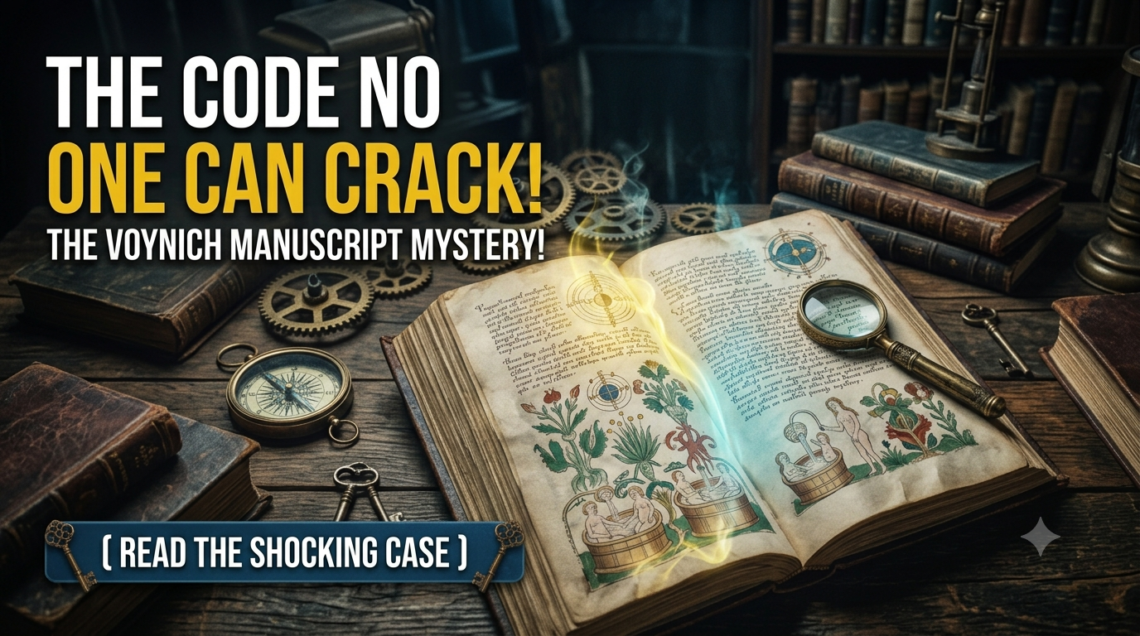
For centuries, historians, language experts, and the world’s most brilliant codebreakers have bent their minds over a single, devastatingly quiet object: a 600-year-old book known as the Voynich Manuscript. It is often called the world’s most mysterious manuscript, and for good reason. It is written in an unknown script, with a syntax no one understands, and is filled with illustrations of things that do not exist.
The puzzle it presents is simple: What does it say?
A Discovery in a Jesuit Library
The manuscript’s modern history begins in 1912. Wilfrid Voynich, a rare book dealer, was visiting a Jesuit college in Italy when he discovered a collection of antique manuscripts hidden in a chest. Among them was the strange, leather-bound volume that now bears his name. Its pages were vellum (animal skin), and its content was unlike anything he had ever seen.
Voynich dedicated the rest of his life to finding someone who could decipher the text, sending photographs to cryptographers, linguists, and anyone who might crack the code. He died without an answer.
A Book Like No Other
The manuscript, now housed at Yale University’s Beinecke Rare Book & Manuscript Library, is fascinating because of what it contains:
- The Text: The entire book is written from left to right in a fluid, unfathomable script. It is an alphabet that has never been seen in any other document, and no one has ever identified the language it represents.
- The “Plants”: The manuscript is filled with illustrations of botanical specimens. Yet, when botanists analyze them, they find only a handful that resemble real-life plants (like a wild pansy or a thistle). The vast majority are fantastic, combining roots, leaves, and flowers that are biologically nonsensical and unknown to earth.
- The “Cosmos”: Other sections contain intricate circular diagrams. Some resemble star maps, others show signs of the zodiac, and some are purely abstract cosmic models that defy clear interpretation.
- The “Nymphs”: Perhaps the strangest section involves hundreds of miniature nude female figures (called nymphs) depicted bathing in interconnected tubs, connected by a bizarre network of pipes and tubes that look like an alchemist’s plumbing system.
The Decryption War
During World War II, elite codebreakers who shattered top-secret Nazi and Japanese codes were brought in to look at the Voynich Manuscript. They failed completely.
In the decades since, powerful computers have been used to analyze the text. Theories abound: it’s a code, a cipher, a constructed language, an archaic tongue like Proto-Romance, or a form of an early medieval hoax. Yet, whenever a new claim of decryption is made, other experts quickly debunk it.
Hoax, Secret, or Something Else?
The manuscript remains a tantalizing enigma. Is it a complex medieval medical reference book written in a secret alchemical script to protect forbidden knowledge? Could it be a masterful 15th-century hoax, designed with brilliant, meaningless complexity to be sold as a high-value curiosity? Or is it a message we simply cannot comprehend, a window into a different way of thinking that has been lost to time?
Until the code is broken, the Voynich Manuscript guards its secrets, reminding us that there are still mysteries that defy all human ingenuity