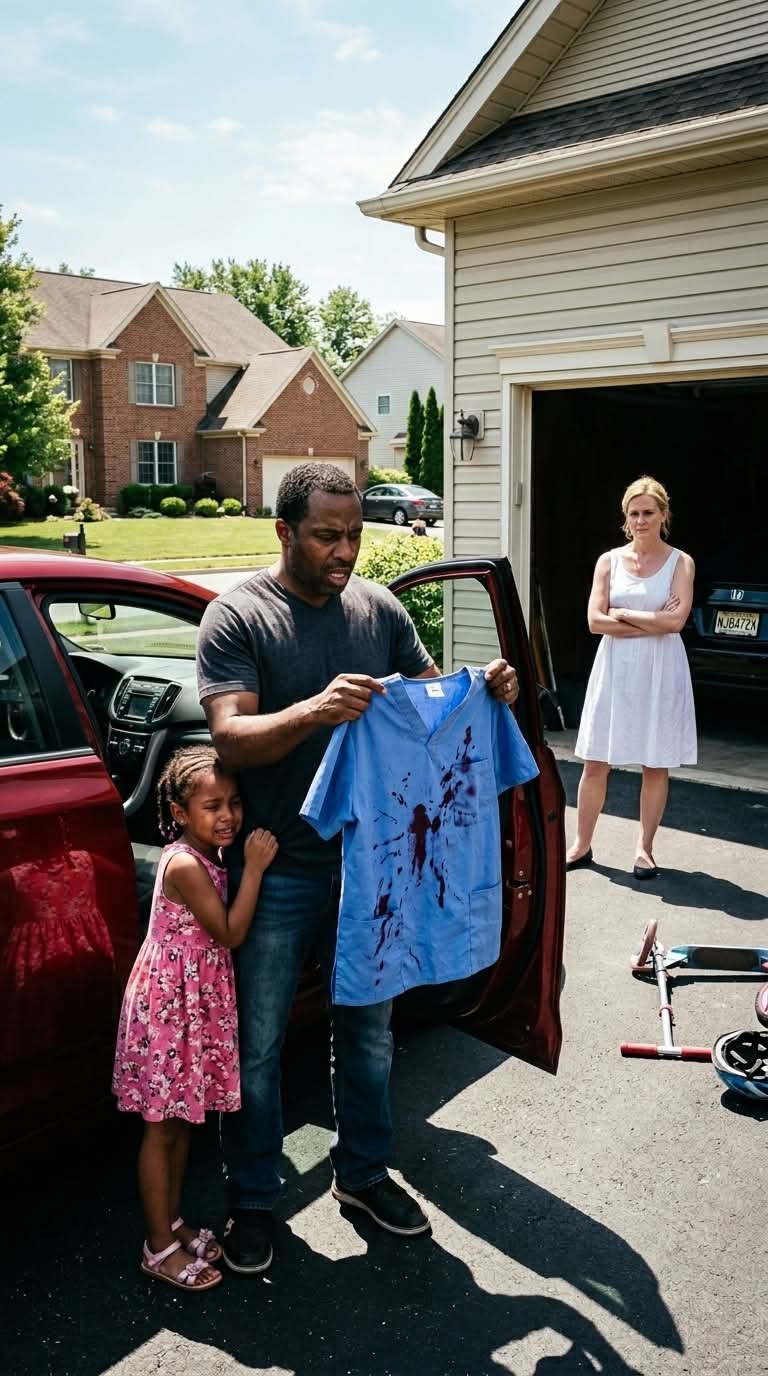
My nine-year-old son, Woody, is currently standing in the center of our sunlit kitchen, casually asking a question I genuinely possess absolutely no idea how to answer.
In exactly sixty seconds, his innocent, observational inquiry is either going to violently destroy my marriage, or miraculously save it. At this precise moment, I am entirely unsure which outcome is approaching.
“Dad, why exactly does Mom change her shirt in the driveway every single day?”
I am staring blankly at him. Woody is calmly holding a tall glass of orange juice, looking up at me as if this is a perfectly normal, mundane question. He is asking this with the exact same casual cadence he uses to inquire about fraction homework or what we are having for dinner.
“What exactly do you mean, buddy?” I ask, my voice sounding hollow and distant to my own ears.
“Mom,” Woody clarifies, taking a slow sip of juice. “When she finally comes home from work, she just sits out there in her car for a really long time. Then, she changes her shirt. I actively watch her from my bedroom window. Sometimes she completely takes off her shirt and puts on a totally different one. Then, she finally comes inside the house.”
My hands instantly, violently freeze on the ceramic coffee mug I am holding.
“How often exactly does this happen, Woody?”
“Every single day. For like… a really long time. Months, maybe.”
“Does she know you are watching her?”
Woody shrugs his small shoulders. “I really don’t think so. My room is directly above the garage. I can see straight down into her windshield.” He pauses, looking incredibly thoughtful. “Sometimes she cries first, Dad. She cries before she changes. Then she aggressively wipes her face with a tissue and comes inside completely smiling.”
The heavy ceramic mug physically slips from my paralyzed grip. It aggressively hits the granite counter. It miraculously doesn’t shatter, but hot, dark coffee violently spills absolutely everywhere.
Because suddenly, every single puzzle piece makes horrifying sense, while simultaneously making absolutely no sense whatsoever.
And the singular, devastating conclusion my brain instantly formulates is that my wife, Jen, is actively carrying on an illicit affair.
Before we plunge completely into this nightmare, please share in the comments exactly where you are watching from today. I genuinely love knowing how incredibly far these stories travel.
It is a mundane Tuesday morning. I am comfortably working from home, exactly as I have for the past five consecutive years. I am a senior software engineer for a massive tech conglomerate headquartered in Seattle. It is a fantastic job, boasting excellent pay and highly flexible hours. This arrangement allows me to consistently be physically present when Woody arrives home from elementary school. I can cook dinner. I can be the actively present, engaged father.
Jen, my wife, is a registered nurse. She works in the high-stakes Intensive Care Unit at Mercy General Hospital located directly downtown. She works grueling, consecutive twelve-hour day shifts, running from 7:00 a.m. to 7:00 p.m., four days a week. The work is physically exhausting and psychologically demanding. She routinely comes home completely drained. But that level of profound exhaustion is entirely normal for critical care nurses, right? The intense stress, the painfully long hours… it comes with the territory.
We have been officially married for eleven years, together for a total of thirteen. We are high school sweethearts. We enthusiastically got married young. We purposely waited to have Woody until we were both twenty-eight. We meticulously built a beautiful, structured life together. We purchased a beautiful, sprawling house in the quiet suburbs, complete with two reliable cars, a golden retriever, the entire, perfectly packaged American Dream.
And I genuinely thought we were incredibly happy. I truly, deeply did.
But now, Woody is casually standing in our kitchen, revealing a massive, glaring behavioral anomaly that I have remained utterly, pathetically oblivious to. Something incredibly significant has been occurring every single day, right under my very nose.
“Buddy,” I say incredibly carefully, desperately trying to keep the rising panic out of my voice. “When you say she changes her shirt, what do you mean, exactly?”
“She takes off the specific shirt she is currently wearing, and she immediately puts on a completely different shirt that she pulls out of a bag. Then, she aggressively shoves the first shirt into the bag.”
“A bag? What specific kind of bag?”
“Like a standard, plastic grocery bag. She always keeps it hidden in the passenger seat of her car.”
“And she explicitly does this every single day?”
“Yeah, absolutely every time she comes home.”
“What about the crying, Woody? You specifically said she cries sometimes.”
Woody nods slowly, suddenly looking incredibly uncomfortable, as if he realizes he might be tattling on his mother. “Not every single day, but a whole lot. She just sits there in the driver’s seat and cries. Then she completely stops, wipes her face clean, changes her shirt, then comes inside and she is totally smiling and happily asking me all about my day and stuff.”
I literally cannot pull oxygen into my lungs. My brain absolutely refuses to process this information.
“Thank you so much for telling me, Woody,” I whisper hoarsely. “You definitely did the right thing.”
“Is Mom going to be okay?” he asks, his brown eyes wide with innocent concern.
“I’m absolutely sure she is fine. You absolutely don’t have to worry about a thing.”
He nods, seemingly satisfied with this parental reassurance, and happily returns to his bowl of cereal.
I stand completely paralyzed in the kitchen, aggressively staring at the spilled, pooling coffee on the expensive granite counter, feeling my entire world violently tilt sideways. I desperately try to shove the terrifying implications out of my mind. I actively try to force myself to focus on my complex coding work, but I am completely incapable.
Why on earth would Jen actively change her clothes in the driveway? Why not just walk inside the house and change in the master bedroom like a normal, rational human being? Why actively sit in the car sobbing first?
The incredibly obvious, glaring answer: She absolutely does not want us to see something specific. She doesn’t want us to know something.
The utterly terrifying, catastrophic answer that I absolutely cannot stop my brain from cycling through: She is actively carrying on an affair.
She is meticulously changing her clothes to aggressively hide physical evidence. She is meeting someone else, driving home, and frantically changing back into her “wife uniform” before daring to cross our threshold. She is crying alone in the car because the crushing guilt is finally consuming her, or perhaps because she is deeply, romantically conflicted. Or, horrifyingly, because she desperately wants to remain with him, but feels obligated to return home to us.
I absolutely hate myself that my logical brain immediately leaps to infidelity. I aggressively hate that I am instantly transforming into the paranoid, suspicious husband cliché. But what other logical explanation makes sense? Why else would a grown woman actively sit in her car, sobbing hysterically, and secretly changing her wardrobe every single day for consecutive months?
That evening, when Jen is scheduled to arrive home, I actively watch. I truly, intensely watch.
At exactly 7:23 p.m., I hear the familiar crunch of her tires pulling onto our concrete driveway. From my strategic vantage point behind the kitchen blinds, I can clearly see her sedan parked directly behind my SUV.
She is sitting perfectly still in the driver’s seat.
I am mechanically chopping vegetables for dinner. Woody is sequestered in his bedroom diligently working on a math assignment. It is an entirely normal, mundane evening, but I am paying acute, agonizing attention now.
7:25 p.m. She is still sitting in the car. She hasn’t even unbuckled her seatbelt yet.
7:30 p.m. Still sitting there, completely motionless.
7:38 p.m. Finally, the heavy car door creaks open. She steps out and walks slowly toward the front door. She is casually wearing faded blue jeans and a soft, gray sweater. Casual. Totally normal.
“Hey, babe,” she sighs, kissing me lightly on the cheek as she enters the kitchen. “I’m so sorry I’m late. The highway traffic was absolutely terrible tonight. How was your day?”
“Totally fine. How was yours?”
“Incredibly long. Deeply exhausting. You know exactly how it is.”
She is already briskly moving down the hallway toward Woody’s room. “Woody! I’m home, buddy!”
I silently watch her walk away. She appears completely fine. Entirely normal. Genuinely happy, even.
But she was sitting alone in that dark car for exactly fifteen agonizing minutes. Doing exactly what?
The following day, Wednesday, I technically log into work, but I am absolutely not working. I am obsessively watching the digital clock on my monitor. I am aggressively waiting for 7:00 p.m. Jen’s exhausting hospital shift formally concludes at seven. It typically takes her exactly twenty minutes to navigate the downtown traffic to our suburb. So, I anticipate her arrival around 7:20 p.m.
At precisely 7:22 p.m., I hear her engine cut out in the driveway.
I instantly creep to the front living room window, peering through the slight gap in the curtains. I watch.
She is sitting in the driver’s seat. The engine is completely off. She is not moving.
I wait. One agonizing minute. Two minutes. Five minutes.
I quietly unlatch the front door and step outside, pretending I am casually checking the mailbox. I walk slowly down the driveway, getting just close enough to clearly hear.
She is crying. She is sitting alone in her dark car with both hands aggressively pressed over her face, violently sobbing. She is desperately trying to remain quiet, exactly as if she is terrified someone might overhear her pain.
My wife is sitting less than twenty feet away from me, weeping uncontrollably in our driveway, and I am standing here completely paralyzed, absolutely unsure of what to do.
After exactly ten agonizing minutes, the violent crying finally ceases. I clearly see her aggressively wipe her face with the back of her sleeve. I watch her physically reach into the dark back seat. I see the distinct movement—the chaotic shifting of fabric—exactly as if she is rapidly changing clothes, precisely as Woody had described.
I quickly, silently back away, retreat inside the house, and forcefully arrange my face into a mask of normalcy.
A few short minutes later, she confidently walks through the front door, offering a bright, manufactured smile.
“Hey! How was your day?” she asks cheerfully.
I desperately want to aggressively interrogate her right there in the foyer. I want to loudly demand answers. But Woody is sitting in the adjacent living room watching television, and I have absolutely no definitive proof of what I am actually confronting her about. Not yet.
“Good,” I lie smoothly. “How was the hospital?”
“Extremely busy. The usual chaos,” she replies smoothly, heading directly to the refrigerator to grab a bottle of water. “What’s the plan for dinner?”
And just like that, the illusion is completely restored. We are instantly back to our manufactured “normal.” Exactly as if she hadn’t just spent twenty minutes hysterically sobbing in a vehicle. Exactly as if everything is perfectly fine.
But it absolutely isn’t fine. Nothing is remotely fine.
Friday evening arrives. Jen texts me to say she is forced to work late. She claims the ICU is severely short-staffed and she generously volunteered to pick up extra hours. Woody is currently attending a sleepover at his best friend’s house.
I am completely alone in the house, and I finally execute something I have absolutely never done in eleven years of marriage. Something I am profoundly, deeply ashamed of.
I quietly walk into the garage, pop the lock on her sedan, and I meticulously, aggressively search it.
I had explicitly suggested she take my larger SUV to work today under the false pretense that I needed to perform routine maintenance on her car. That was a blatant lie designed entirely to secure access.
I violently tear through the glove compartment first. Vehicle registration, the insurance card, a stale pack of peppermint gum. Completely mundane, normal stuff.
Then, I finally spot it. Aggressively shoved entirely under the passenger seat is a crinkled, plastic grocery bag.
I pull it out with trembling hands and tear it open.
Inside are clothes. Women’s clothing. Specifically, a blue hospital scrub top.
But it absolutely isn’t clean. There are severe, dark stains aggressively splattered across the fabric. Dark, rusted stains that clearly failed to wash out in the laundry. And the smell…
The plastic bag smells overwhelmingly of harsh, industrial chemical cleaner mixed with something else entirely. Something incredibly metallic, chemical, and deeply unpleasant.
There is also a small glass bottle of perfume tucked inside the bag. An incredibly expensive, high-end brand. It is absolutely not the light, floral perfume Jen typically wears. This specific scent is incredibly heavy, aggressive, and overpowering.
I continue my frantic search. Inside the center console, I discover a crumpled stack of paper receipts. I rapidly pull them out and meticulously sort through them.
Three specific receipts are from a small, independent coffee shop named Brew Haven. The timestamps are all from the past two consecutive weeks. It is absolutely not an establishment we have ever visited together, nor is it a place she has ever casually mentioned in conversation.
And buried directly underneath those coffee receipts are printed tickets from a commercial parking garage located downtown.
Address: 447 Pine Street.
Date stamps indicating regular visits spanning the entire past three months. Multiple, recurring receipts. She has been aggressively frequenting this location.
I instantly pull out my smartphone and aggressively Google the address. 447 Pine Street.
It is a massive, high-end residential apartment complex situated perfectly downtown, exactly twenty minutes away from Mercy General Hospital.
My stomach violently drops into my shoes. My hands are shaking so aggressively I nearly drop the phone.
Why on earth would Jen be regularly paying for parking at a luxury apartment building? Why would she possess receipts from a strange coffee shop I have absolutely never heard of? Why is she aggressively changing her clothes and desperately hiding a heavy, expensive perfume?
The ultimate, horrifying answer is so incredibly obvious it physically hurts my chest. It absolutely confirms all my darkest, most paranoid suspicions.
She is actively seeing someone else.
She is secretly meeting a lover at his downtown apartment. She is visiting him immediately after her grueling hospital shifts, or perhaps right before. She is meticulously changing her clothes in the driveway to aggressively destroy physical evidence. She is sobbing violently in the car because the crushing guilt is finally eating her alive. And then, she is cheerfully walking into our home, flawlessly pretending our entire life is perfectly normal.
I sit paralyzed in the driver’s seat of her car, clutching the plastic bag of stained scrubs and the damning receipts, and I genuinely want to violently vomit.
Eleven years. We have been legally married for eleven long years. We created a beautiful son together. We built an entire, secure life. And she has been expertly, ruthlessly lying to my face for months.
I absolutely do not confront her that specific Friday night. I don’t utter a single, suspicious syllable when she finally walks through the door at 9:00 p.m., looking absolutely, profoundly exhausted. I don’t aggressively mention the unknown coffee shop, the luxury apartment building, or the hidden bag of clothing.
I just quietly sit on the sofa and intensely watch her.
I desperately try to identify the lie. I try to pinpoint the visible evidence of the affair.
But she is incredibly, flawlessly good at this. She walks over and gently kisses my forehead. She eagerly asks about my boring workday. She asks how Woody’s sleepover is going. She casually makes a lighthearted joke about desperately needing a hot shower because she “smells exactly like a sterile hospital.”
She is so incredibly, terrifyingly good at this deception. So utterly convincing. How long, exactly, has she been effortlessly lying to me?
Throughout the entire agonizing weekend, I can barely physically function. I can barely even force myself to look her directly in the eyes. She notices my distance and gently asks if I am feeling okay. I aggressively lie and claim I am just experiencing severe work-related stress. She immediately believes me—or she flawlessly pretends to.
Monday morning arrives. She kisses me goodbye and leaves for her hospital shift at exactly 6:30 a.m.
The very second her car clears the driveway, I make a permanent, irrevocable decision. I am going to uncover the absolute, undeniable truth. I am going to physically follow her.
I immediately call my manager and falsely report that I am severely ill. I send a quick email to my team, and then I climb into my SUV and aggressively drive downtown to Mercy General Hospital.
I park strategically across the busy street, ensuring I have a clear line of sight to the employee entrance. And I wait.
At exactly 7:15 a.m., I clearly see her briskly walking through the hospital’s automatic glass doors, fully dressed in her blue medical scrubs. So, she genuinely does report to her job. At least during the morning hours.
I remain parked in that exact spot for the entire, agonizing day. Sitting alone in my vehicle exactly like a deranged stalker. Exactly like a paranoid, unhinged husband. Exactly like absolutely everything I never, ever wanted to become.
At 6:45 p.m., the hospital doors slide open. She walks out, still wearing her medical scrubs. She climbs into her sedan and slowly exits the employee parking structure.
I immediately pull into traffic and aggressively follow her. I strategically maintain a distance of three or four cars between us. I feel exactly as if I am participating in a terrible, low-budget espionage movie, but I desperately need to know the truth.
She absolutely does not drive toward our suburban home.
She navigates deeper into the downtown grid, ultimately taking the specific exit for Pine Street.
My heart is violently pounding against my ribcage. This is it. This is the absolute, undeniable proof.
She pulls directly into the parking garage at 447 Pine Street.
I wait thirty seconds, then aggressively follow her inside. I park my SUV a few rows away and sink low in my seat. I watch.
She steps out of her car and walks incredibly slowly toward the elevator bank. She looks profoundly tired. Entirely defeated. She absolutely does not possess the energetic, eager demeanor of a woman rushing to meet an illicit lover. But my cynical brain immediately rationalizes that observation: Perhaps that is a fundamental part of the affair. Perhaps the massive guilt is finally, violently consuming her.
I wait exactly five agonizing minutes, then I exit my vehicle and follow her path. I take the elevator up, but I have absolutely no idea which specific floor she selected. The luxury building boasts twelve massive floors. I am desperately, hopelessly guessing, praying I will catch a glimpse of her walking down a hallway.
I step out onto the fourth floor. I rapidly walk the long, carpeted corridors. Absolutely nothing. I take the stairs to the fifth floor. Nothing.
I eventually surrender. I retreat to my SUV and I wait.
Exactly an hour later, she finally emerges from the elevator bank.
She has completely changed her clothing. The medical scrubs are gone. She is now wearing faded jeans and a comfortable sweater—the exact same outfit she wore home the previous night.
She climbs back into her car and immediately drives toward our suburb. I follow her from a safe distance. She drives straight to our house and pulls perfectly into the garage.
I park a block away, wait an agonizing ten minutes, and then casually pull into my own driveway.
When I walk through the front door, she is standing happily in the kitchen, actively stirring a pot of pasta sauce, offering a bright, beautiful smile.
“Hey, honey! How was your day?” she asks cheerfully.
“Fine,” I lie, my voice completely devoid of emotion. “Yours?”
“Oh, incredibly exhausting,” she sighs dramatically. “But it is finally over now.”
I desperately want to scream at the top of my lungs. I want to aggressively demand to know exactly where she truly was, exactly who she was intimately with, and exactly why she secretly changed her clothes inside a luxury apartment building.
But I absolutely do not utter a single word. Because I am not fully prepared for the explosion yet. Because I desperately need a structured plan.
On Tuesday morning, I finalize my decision. I am going to aggressively confront her. But I am going to execute it properly. No sudden ambush in the kitchen. No hysterical screaming matches in front of our son. I am just going to ask her directly. I will grant her one final, merciful opportunity to willingly tell the truth.
I send her a text message during her lunch break.
Can we please schedule a proper date night this week? I’ll secure a babysitter for Woody. Just the two of us. We desperately need to talk.
She responds exactly twenty minutes later.
Is everything okay, Jason?
Yeah. I just really want to spend some quality time together. Talk about some important stuff.
Okay. Thursday works perfectly.
I immediately arrange for Woody to spend Thursday night at my parents’ house. I lie and claim Jen and I desperately need a romantic date night. They are thrilled to accommodate us, noting that we absolutely don’t spend enough time alone together. They are entirely correct. We don’t. Because we have been actively living two completely separate, parallel lives. And I was completely oblivious to the reality until my nine-year-old son literally pointed it out to me.
Thursday arrives. The day I have been violently dreading. The day that will fundamentally alter the trajectory of our entire lives.
I specifically make a reservation at Morello’s—the upscale Italian restaurant where we joyfully celebrated our first wedding anniversary. The venue is public enough that she likely won’t create a massive, hysterical scene, but the booths are private enough that we can conduct a serious conversation.
Jen appears incredibly nervous while applying her makeup in our bathroom. She repeatedly asks if I am absolutely certain everything is fine. I repeatedly, falsely assure her that it is.
We drop Woody at my parents’ house at 5:00 p.m. We drive the entire twenty minutes to the restaurant in absolute, suffocating silence. She desperately attempts to initiate mundane small talk. I offer only cold, one-word responses.
We sit down at our secluded booth. The waiter pours our wine. She is intensely staring at me, her eyes wide, exactly as if she is bracing for a catastrophic medical diagnosis.
“Jason, please,” she pleads softly. “What exactly is going on? You have been incredibly distant all week. Is it a severe problem at work?”
This is it. The absolute point of no return.
“I need to ask you a very specific question, Jen,” I state, my voice dropping to a low, serious octave. “And I desperately need you to be completely, brutally honest with me.”
“Okay,” she replies. Her voice is incredibly careful, deeply scared.
“Why exactly do you change your clothes in our driveway every single day?”
She instantly freezes. All the color rapidly drains from her face, leaving her skin a sickly, pale white.
“What?” she breathes out.
“Woody explicitly told me,” I continue relentlessly. “He actively watches you from his bedroom window. He told me you sit alone in the car, sometimes you cry hysterically, then you change your shirt, and then you finally come inside. He says you have been executing this routine for months.”
She is aggressively staring at me, completely paralyzed, incapable of speech.
“I found the hidden plastic bag inside your car, Jen,” I press harder, refusing to let her off the hook. “I found the stained clothes. I found the heavy perfume. And I found the receipts. The receipts from the coffee shop, and the recurring parking garage receipts from Pine Street. The luxury apartment building.”
Her hands begin to shake violently against the white tablecloth.
“I actively followed you on Monday,” I confess, delivering the final blow. “I watched you walk directly into that building. I watched you walk out an hour later wearing completely different clothes. So, I need you to look me in the eye and tell me the absolute truth right now. Who exactly is he? How long has this affair been going on?”
The heavy, damning words hang suspended in the air between us. Incredibly final. Absolutely devastating.
“He?” she repeats, her voice barely a whisper.
“Yes, Jen. He. Who exactly is the guy you are secretly seeing?”
“Her name is Natasha.”
I remain completely silent for a long moment, my brain aggressively trying to reconfigure the data. “Are you… are you actively cheating on me with a woman?”
Jen’s entire face violently crumples. Massive, heavy tears instantly begin streaming rapidly down her cheeks. She is frantically shaking her head.
“Oh my god, Jason. No,” she gasps. “I was desperately trying to convince myself you weren’t implying what you clearly were. There is absolutely no one, Jason. There is no sordid affair. There is absolutely no other man, and there is no other woman.”
“Then accurately explain it to me!” I demand, my voice rising slightly. “Explain the secret apartment building! Explain the hidden clothes, the crying in the driveway, the endless lying!”
“I am absolutely not lying to you!” she cries out. “I just… I desperately didn’t want you to know!”
“Didn’t want me to know what, Jen?”
“That I am completely, totally falling apart!”
Her voice breaks violently. She is actively sobbing now. Deep, full, heaving sobs. Patrons at the adjacent tables are visibly turning their heads to stare at us.
“The luxury apartment building,” she chokes out, desperately wiping her eyes. “That is exactly where my therapist’s office is located. Dr. Natasha Reynolds. I have been actively attending intensive therapy sessions twice a week for the past four months. That is exactly where I go. That is exactly why I park in that garage.”
I am completely frozen, aggressively staring at her as if she were speaking a foreign language. “A therapist?”
“Yes. I voluntarily started intensive therapy back in November.”
“And the coffee shop?”
“That is exactly where I sit for thirty minutes after my difficult sessions,” she explains, her chest heaving. “Because I absolutely cannot drive my car immediately after talking to her. I desperately need time to compose myself. I need time to process the trauma. I need time to physically stop crying.”
“Why on earth are you in intensive therapy, Jen? Why didn’t you tell me this?”
She violently wipes her wet face with a linen napkin and takes a deep, incredibly shaky breath.
“Because I am actively drowning, Jason. I have been aggressively drowning for years, and I desperately didn’t want you to carry the burden. I didn’t want to break you. I didn’t want Woody to watch his mother completely fall apart.”
“What exactly are you talking about?”
“My job, Jason! The ICU! I literally work inside of hell!”
Her voice rises, filled with an ancient, agonizing pain. “Jason, do you possess any actual concept of what I do every single day? I actively watch human beings die. I physically hold their hands while the life leaves their bodies. I am the one who has to dial the phone and tell screaming families that their loved one didn’t miraculously survive. I see horrific, terrible things that I absolutely cannot unsee!”
She is crying significantly harder now, barely able to articulate the words.
“During the pandemic… it was an absolute, unending nightmare. We lost so many innocent people. So incredibly many. And we were entirely alone in those rooms because families were legally barred from visiting. So, I held their hands. I stayed by their bedsides. I was the absolute last human face they ever saw. Complete strangers dying terrified, and I was the only person sitting there with them!”
“Jen…” I whisper, my heart physically aching.
“And after the pandemic officially ended, society assumed the trauma would magically disappear,” she gasps. “But it absolutely didn’t. Human beings still violently die in the ICU, Jason. Every single week. Horrific car accidents, massive heart attacks, devastating strokes, aggressive overdoses. Young teenagers, elderly grandparents, people with terrified families waiting anxiously in the hallway. And I am forced to be the one to walk out there and tell those families that we tried everything scientifically possible, but it simply wasn’t enough.”
She takes a ragged, desperate breath between her sobs.
“I developed severe PTSD, Jason. That is exactly what Dr. Reynolds diagnosed. Post-Traumatic Stress Disorder directly resulting from my career. From aggressively watching people die over and over and over again. From carrying all that immense death, all that suffocating grief, entirely on my own shoulders.”
My throat is incredibly tight. I am completely incapable of speaking.
“The dirty clothes hidden in the bag,” she continues, her voice violently breaking. “Those are my medical scrubs. My actual work scrubs. They literally have human blood stained on them, Jason. Blood that absolutely will not wash out in the machine, no matter how many times I aggressively bleach them. It is blood from critical patients I desperately tried to save, but couldn’t.”
She looks at me, her eyes filled with absolute desperation.
“I absolutely cannot bring those specific scrubs inside our safe house. I cannot let Woody accidentally see them. I cannot let him smell that distinct hospital smell. The sharp smell of death. The heavy perfume you found? I exclusively use it to aggressively cover the scent. Because even after I change my clothes, even after I scrub myself in the hospital showers, I can still vividly smell it on my skin. The harsh disinfectant, the copper blood, and the death. So, I douse myself in strong perfume to meticulously mask it. So that when I hug Woody in the kitchen, he doesn’t smell death lingering on his mother.”
I genuinely feel as though I have been violently punched directly in the stomach by a heavyweight boxer.