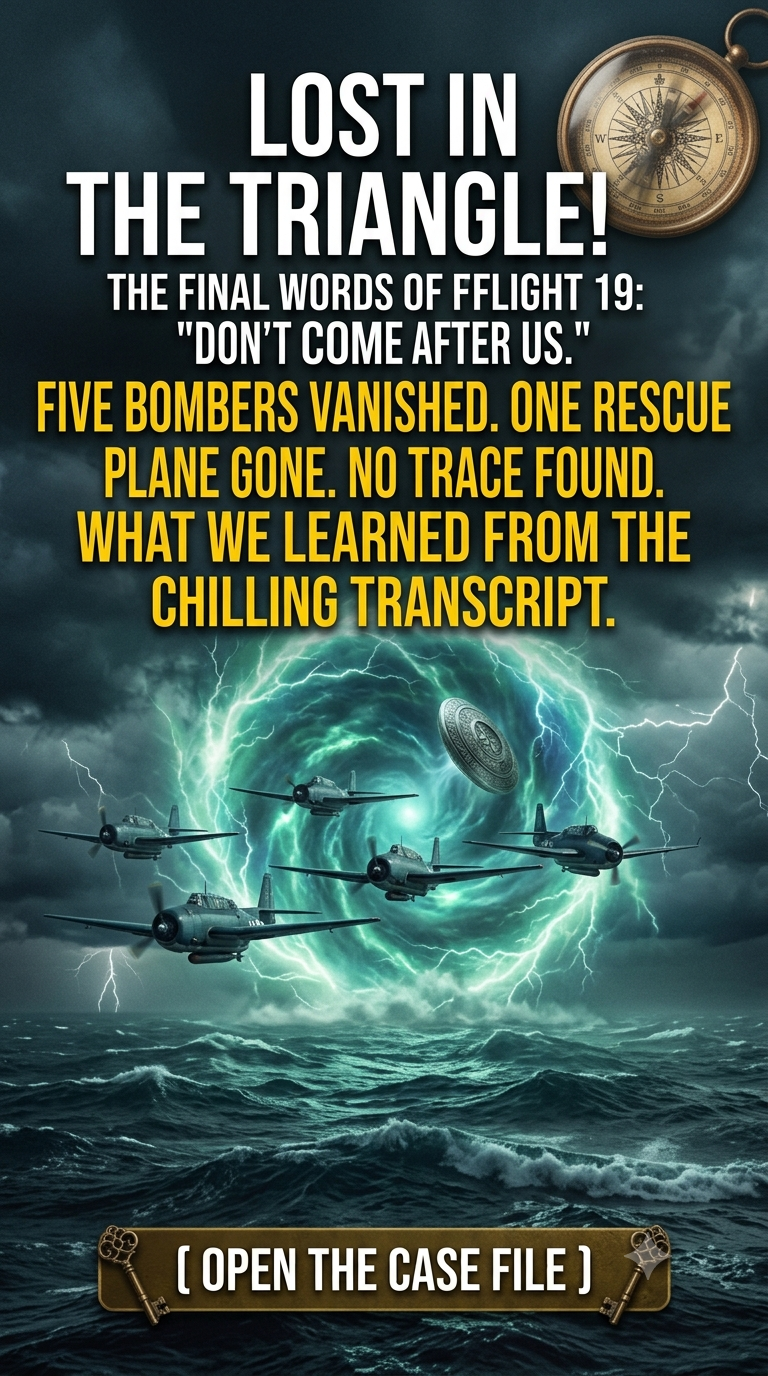
On December 5, 1945, five US Navy Avenger torpedo bombers took off from Fort Lauderdale, Florida, for a routine three-hour training mission over the Atlantic. The weather was clear, the pilots were experienced, and the planes were fully fueled and tested. It was supposed to be a simple exercise.
But three hours later, the mission turned into one of the most terrifying mysteries in aviation history.
The flight leader, Lieutenant Charles Taylor, suddenly radioed the control tower. His voice wasn’t calm; it was filled with panic. “We seem to be lost,” he said. “We cannot see land. Everything looks wrong. Even the ocean doesn’t look as it should.”
The tower tried to guide them back, but the planes’ compasses had completely malfunctioned, spinning wildly in circles. As the sun set, a heavy, unexpected fog rolled in. The radio signals began to fade into heavy static, but the tower managed to catch one last chilling sentence from one of the pilots:
“They look like they’re from outer space… don’t come after us…”
After that, silence. Flight 19, along with its 14 crew members, vanished without a trace.
The military immediately launched one of the largest search-and-rescue operations in history. A massive rescue flying boat, the Mariner, with a crew of 13 men was sent to search for them. But within minutes of entering the same airspace, the rescue plane also vanished from the radar. No debris, no oil slicks, and no bodies from any of the six aircraft were ever found.
The US Navy’s official report concluded with a haunting phrase: “We are not able to even make a good guess as to what happened.”
This tragic event was the birth of the legend of the Bermuda Triangle. Decades later, scientists, historians, and conspiracy theorists still argue: did they suffer a massive mechanical failure, or did they enter a portal to another dimension from which no one ever returns?